NeuMesh++ introduces a mesh-based neural radiance representation for versatile and efficient volumetric editing. The method encodes geometry, texture, and semantic features as disentangled vertex-bounded codes on a mesh scaffold, enabling mesh-guided geometry deformation, texture swapping, texture filling, texture painting, and semantic-guided editing. NeuMesh++ improves rendering quality and training stability through a local space parameterization and post-interpolation strategy, supports high-fidelity texture edits with a learnable per-vertex modification color, and enables precise edits through spatial-aware optimization and semantic-aided region selection. Experiments on real and synthetic datasets show strong rendering quality, efficient interaction, and flexible geometry and texture editing.
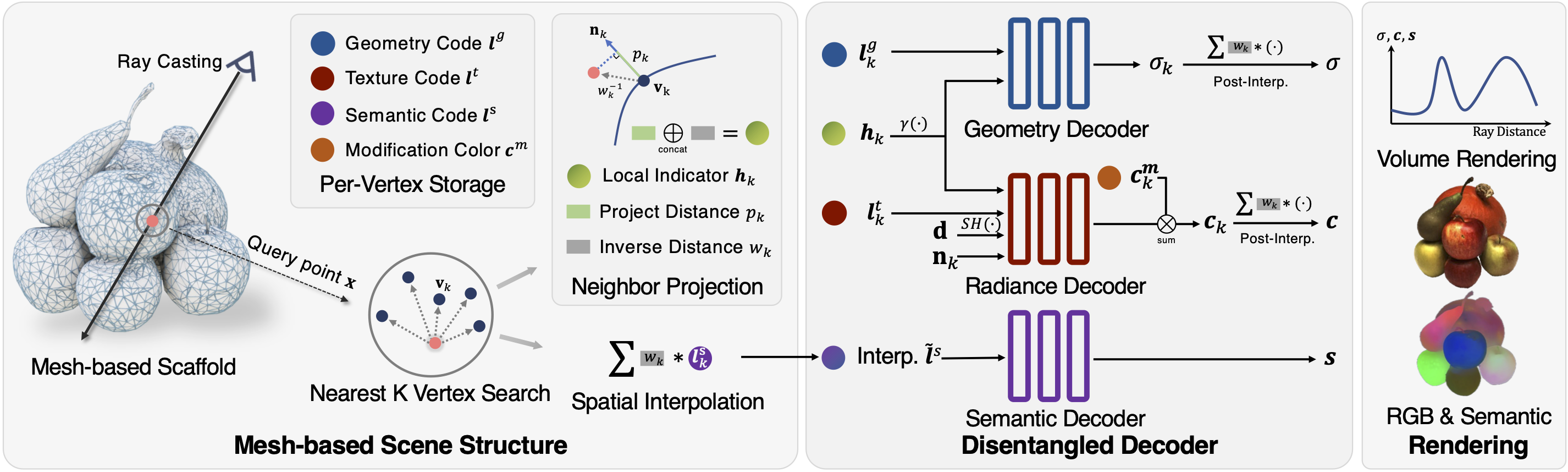
NeuMesh++ represents a neural radiance field on a mesh scaffold, where each vertex stores disentangled geometry, texture, and semantic codes, plus a decoder-free modification color for high-fidelity texture edits. For each sampled query point along a camera ray, nearby mesh vertices provide local codes and local indicators; lightweight geometry and radiance decoders predict per-vertex density and color contributions, which are then fused by post-interpolation. Semantic features are decoded from interpolated semantic codes to support click-based 3D region selection, while the mesh scaffold keeps editing compatible with standard mesh workflows.
NeuMesh++ supports semantic-guided editing, where users click on a rendered view to propagate a semantic 3D region and then apply targeted geometry or texture edits with immediate neural-field preview.
Users deform the mesh scaffold directly, and the aligned neural radiance field follows the edited shape without additional fine-tuning.
NeuMesh++ can combine mesh-guided neural rendering with physical simulation, producing dynamic deformations such as bouncing or swaying objects.
A single-view click can propagate to a semantic 3D mesh region, enabling targeted geometry edits without dense manual annotation.
The method transfers texture codes and modification colors between selected mesh regions while preserving the target geometry.
Selected regions can be filled with repeated material patterns from pre-captured source models using UV-space texture-code transfer.
Users paint on a single rendered view, and NeuMesh++ transfers the strokes into the 3D radiance field for consistent novel-view rendering.
Semantic vertex codes allow users to select a meaningful object region from one clicked view and apply texture edits to the corresponding 3D area.
NeuMesh++ supports combined edits such as geometry deformation, texture painting, and texture filling in the same object.
@article{bao2025neumesh++,
  title={NeuMesh++: Towards Versatile and Efficient Volumetric Editing with Disentangled Neural Mesh-based Implicit Field},
  author={Bao, Chong and Li, Yuan and Yang, Bangbang and Shen, Yujun and Bao, Hujun and Cui, Zhaopeng and Zhang, Yinda and Zhang, Guofeng},
  journal={IEEE Transactions on Pattern Analysis and Machine Intelligence},
  year={2025},
  publisher={IEEE}
}