Dirichlet Boundary Conditions
Prescribed regions remain fixed while the unconstrained domain deforms under external forces.
1State Key Laboratory of CAD&CG, Zhejiang University
2Beijing Institute for General Artificial Intelligence (BIGAI)
3Ant Group 4Shenzhen University 5University of British Columbia
† Corresponding author
Generalizing real-time physics-based animation across diverse 3D shapes and spatial discretizations remains challenging. In this paper, we introduce PhysSkin++, a physics-informed framework that learns continuous neural skinning fields from static geometries to construct compact deformation subspaces. Specifically, we propose a Neural Skinning Fields Autoencoder that predicts shape-dependent deformation subspaces without per-object network training. To learn these subspaces without simulation trajectories, we develop a Physics-Informed Self-Supervised Learning strategy that combines skinning-field normalization with conflict-aware gradient correction, stabilizing joint optimization under physical and orthogonality constraints. The learned representation supports efficient reduced dynamics with user control and contact interactions, together with direct animation binding to meshes, point clouds, and 3D Gaussians. For prescribed rig animation, we further introduce a self-supervised complementarity objective to learn complementary elastic responses without enforcing complementarity constraints at runtime. Experiments demonstrate cross-shape generalization of the learned skinning fields, real-time reduced simulation, and applications to controllable, collision-aware, and rig-complementary animation.
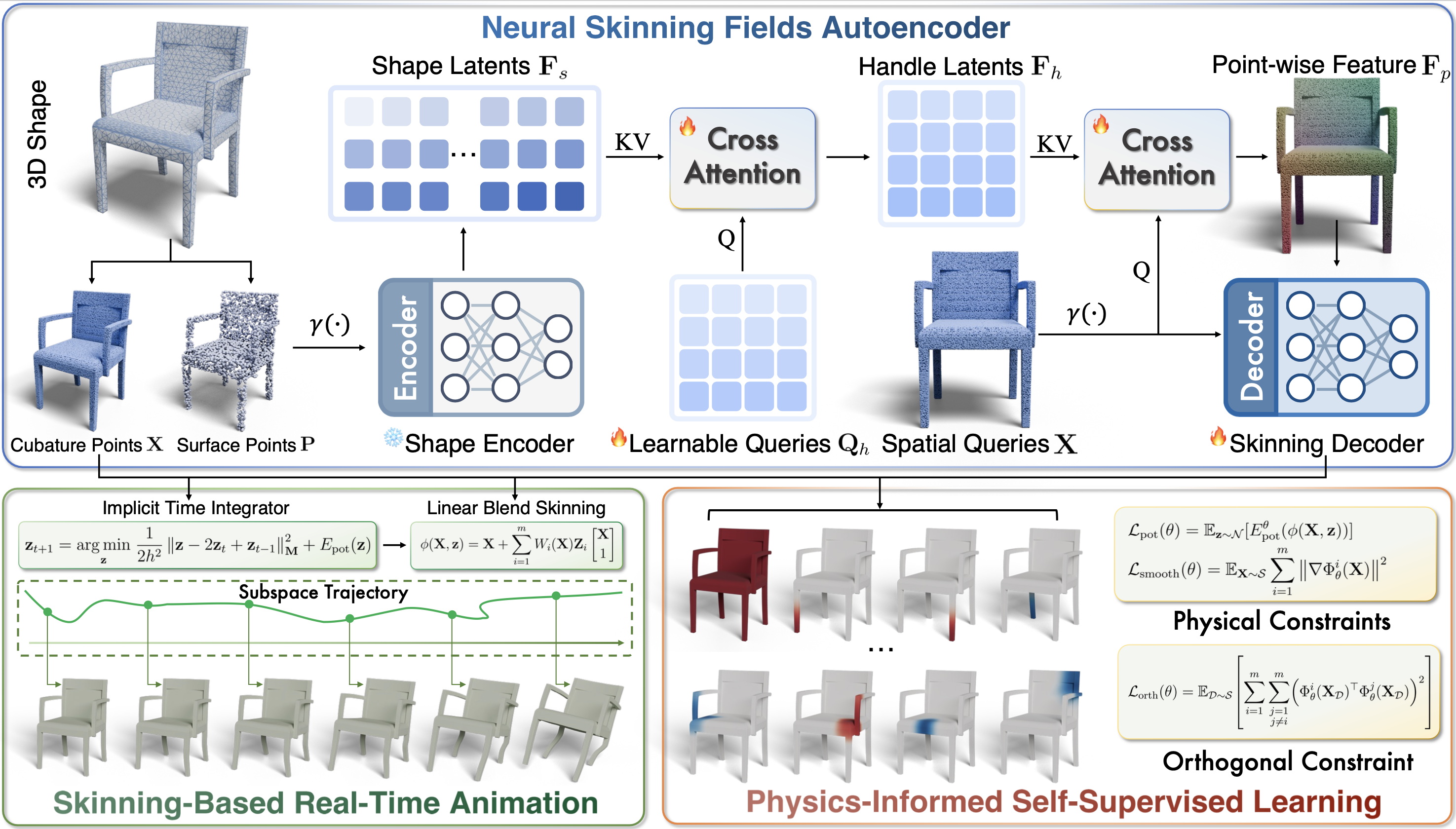
Given a static 3D shape, the framework samples volumetric cubature points for animation and surface points for shape encoding. A shape encoder produces shape latents, from which learnable queries extract handle latents through cross-attention. Spatial queries then attend to these handle latents and decode continuous neural skinning fields. Geometry-only, physics-informed self-supervision optimizes the fields under physical, smoothness, and orthogonality objectives.
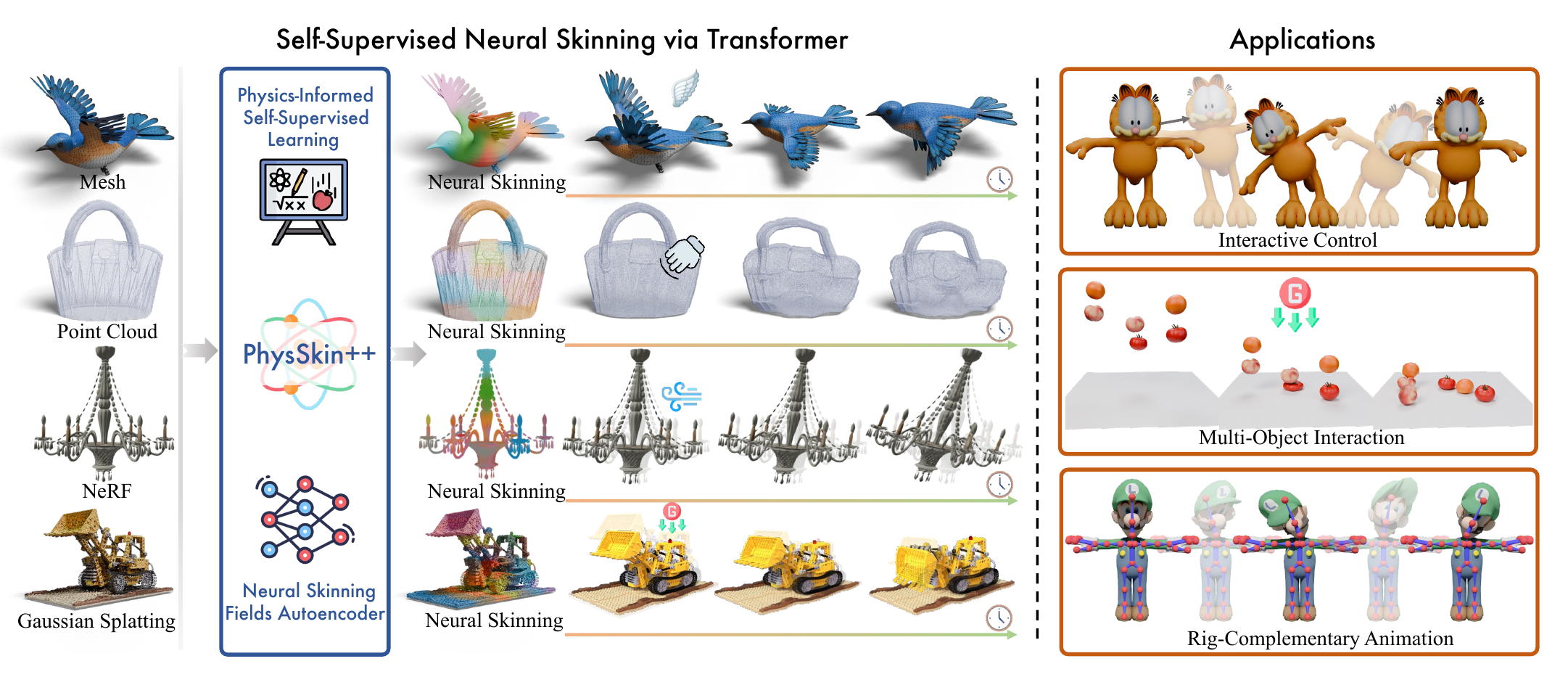
PhysSkin++ supports diverse real-time physics-based animations through Dirichlet boundary conditions, interactive dragging, and energy-based boundary penalties for environmental contact.
Prescribed regions remain fixed while the unconstrained domain deforms under external forces.
Users manipulate localized regions of a deformable object through directly applied drag forces.
Boundary-penalty energies model contact between deformable objects and a single inclined plane.
The same boundary-penalty formulation supports sequential contact across multiple planar boundaries.
A point-based IPC-style barrier models inter-object contact, while boundary-penalty energies handle contact with the supporting floor.
Falling rigid bodies transfer collision responses to deformable objects through the shared contact formulation.
Multiple deformable objects are simulated jointly as inter-object contacts evolve over time.
PhysSkin++ enriches rig-based primary animation with physics-based complementary deformation.
Through an interactive rig interface, users manipulate bone poses while PhysSkin++ adds complementary elastic deformation.
PhysSkin++ enriches user-authored rig animation sequences with physics-based complementary elastic deformation.
PhysSkin++ predicts physically consistent neural skinning fields across different geometries.
@inproceedings{lei2026physskin,
  title     = {PhysSkin: Real-Time and Generalizable Physics-Based Animation via Self-Supervised Neural Skinning},
  author    = {Lei, Yuanhang and Cheng, Tao and Li, Xingxuan and Zhao, Boming and Huang, Siyuan and Hu, Ruizhen and Chen, Peter Yichen and Bao, Hujun and Cui, Zhaopeng},
  booktitle = {Proceedings of the IEEE/CVF Conference on Computer Vision and Pattern Recognition (CVPR)},
  year      = {2026}
}