
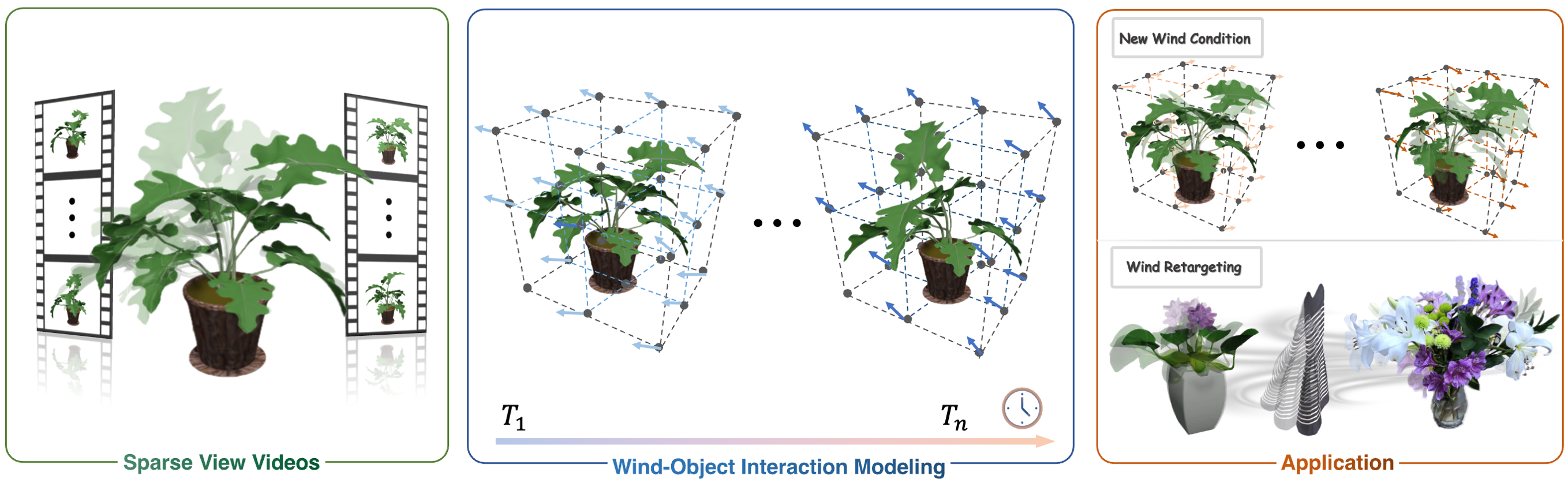
DiffWind is a physics-informed differentiable wind-object interaction framework that models wind and object dynamics separately. This design enables the reconstruction of wind and object motion from sparse-view videos, physically consistent simulation under new wind conditions, and retargeting to novel objects.
Modeling wind-driven object dynamics from video observations is highly challenging due to the invisibility and spatio-temporal variability of wind, as well as the complex deformations of objects. We present DiffWind, a physics-informed differentiable framework that unifies wind-object interaction modeling, video-based reconstruction, and forward simulation. Specifically, we represent wind as a grid-based physical field and objects as particle systems derived from 3D Gaussian Splatting, with their interaction modeled by the Material Point Method (MPM). To recover wind-driven object dynamics, we introduce a reconstruction framework that jointly optimizes the spatio-temporal wind force field and object motion through differentiable rendering and simulation. To ensure physical validity, we incorporate the Lattice Boltzmann Method (LBM) as a physics-informed constraint, enforcing compliance with fluid dynamics laws. Beyond reconstruction, our method naturally supports forward simulation under novel wind conditions and enable new applications such as wind retargeting. We further introduce WD-Objects, a dataset of synthetic and real-world wind-driven scenes. Extensive experiments demonstrate that our method significantly outperforms prior dynamic scene modeling approaches in both reconstruction accuracy and simulation fidelity, opening a new avenue for video-based wind–object interaction modeling.
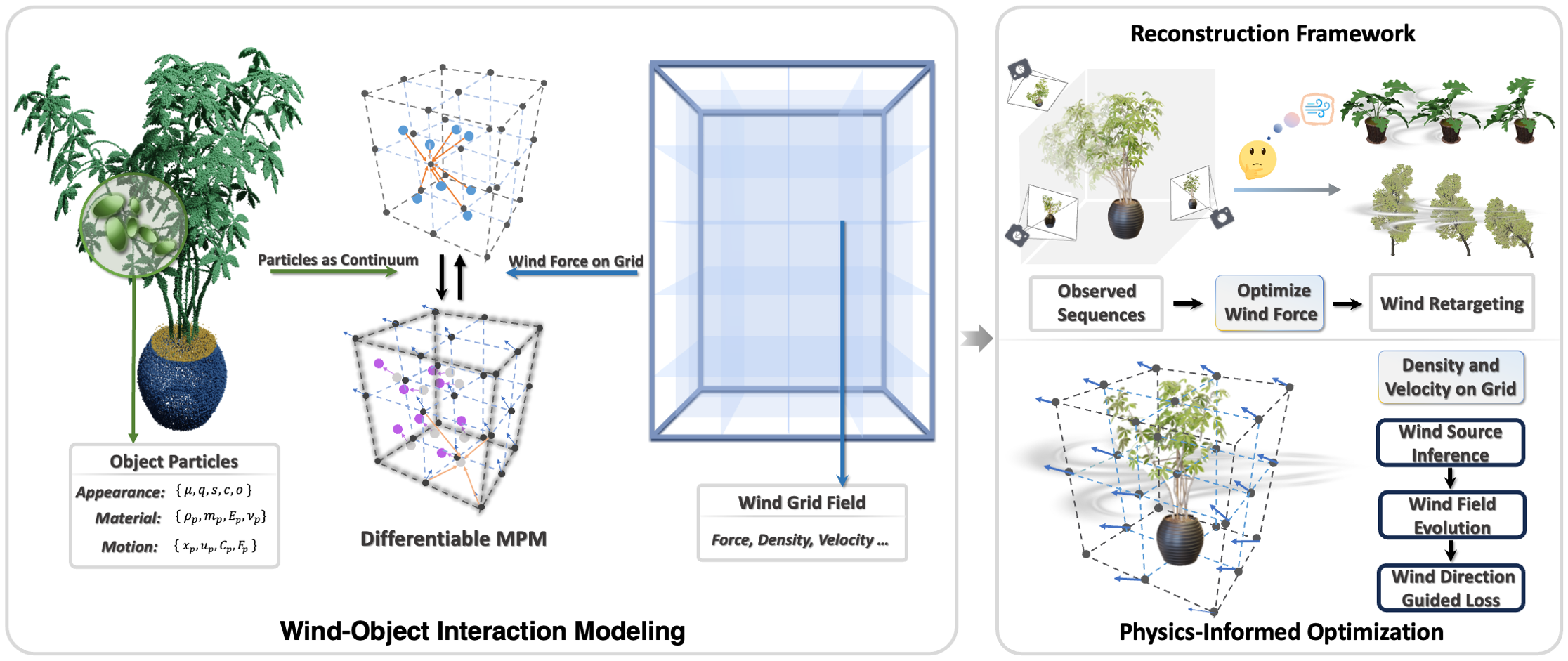
Overview of DiffWind. We propose a novel wind-object interaction modeling approach, where the wind is represented as a grid field and the object is modeled as a set of particles. Based on this modeling approach, we introduce a reconstruction framework for wind–object interaction by optimizing the wind force field. In addition, we employ the Lattice Boltzmann Method (LBM) to generate wind force field direction guidance to enforce compliance with fluid dynamics laws.
@inproceedings{lei2026diffwind,
  title     = {DiffWind: Physics-Informed Differentiable Modeling of Wind-Driven Object Dynamics},
  author = {Lei, Yuanhang and Zhao, Boming and Yang, Zesong and Li, Xingxuan and Cheng, Tao and Peng, Haocheng and Zhang, Ru and Yang, Yang and Huang, Siyuan and Shen, Yujun and Hu, Ruizhen and Bao, Hujun and Cui, Zhaopeng},
  booktitle = {Proceedings of the Fourteenth International Conference on Learning Representations (ICLR)},
  year      = {2026},
  url       = {https://openreview.net/forum?id=vKVzihkbQo}
}